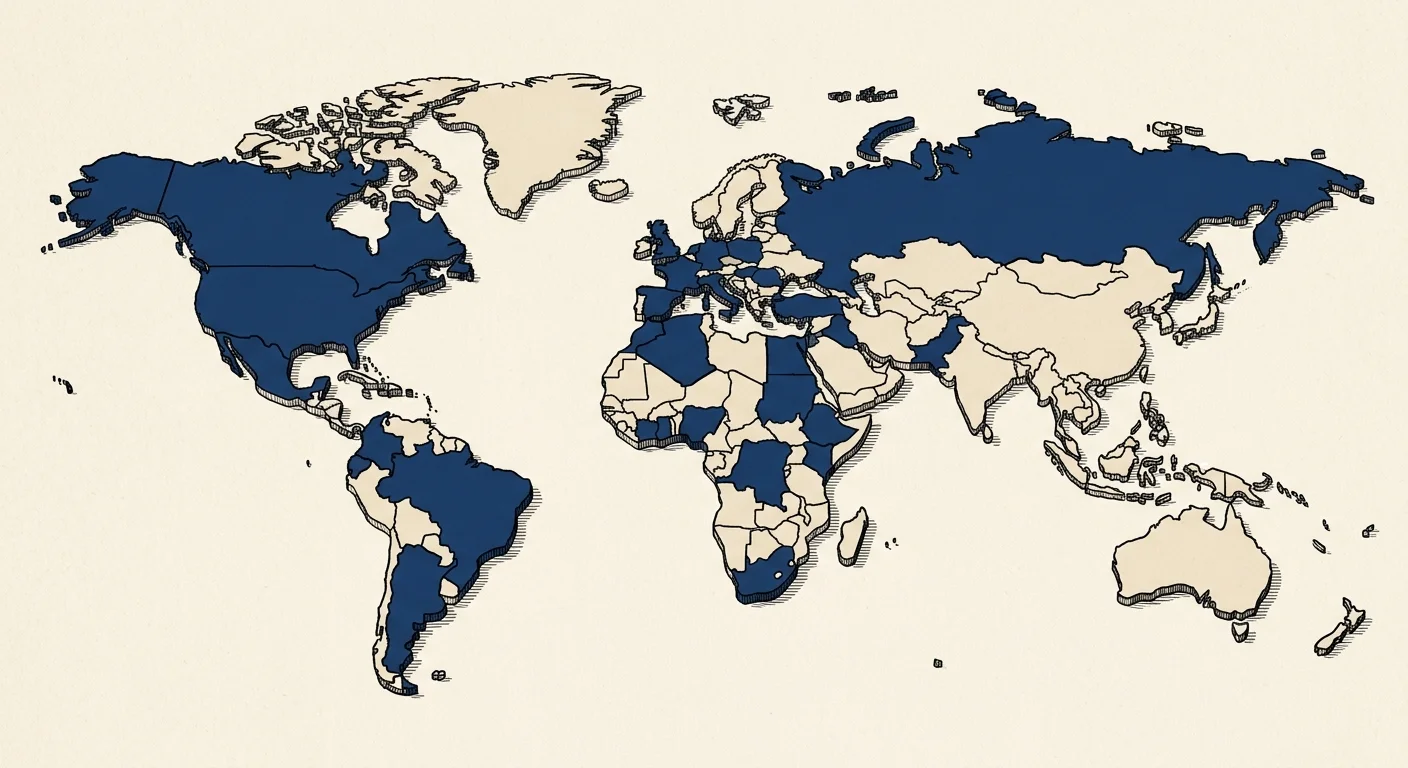
FIFA tracks 191 countries in its 2014 audience data. 51 of them registered as zero.
Mongolia is a FIFA member. It has played in AFC qualifying rounds. At the 2014 World Cup, FIFA's measurement system recorded Mongolia as 0.0 percent of the global TV audience — not a small number, but no number at all. The same is true for population share and GDP-weighted share: 0.0 across all three measures.
This is not a rounding issue. It means Mongolia was not in the measurement system. 50 other FIFA members were in the same position.
Share of FIFA members invisible in 2014 audience data, by confederation
Percentage of FIFA member nations with no TV audience data in the 2014 World Cup.
Source: FiveThirtyEight, 2014 World Cup data
The invisibility is not random — it follows a clear geographic pattern. The Pacific (OFC) is the most unmeasured region: 10 of 12 member nations, including Fiji, Samoa, Tonga, and Vanuatu, produced no audience measurement. The Caribbean and Central America (CONCACAF) had 17 of 30 members invisible.
Europe (UEFA) had only 5 of 46 invisible — all small nations. South America (CONMEBOL) had zero invisible members.
This is not a story about small countries. Qatar — a wealthy nation that hosted the 2022 World Cup — was invisible in 2014. So were Oman, Bahrain, Brunei, and Macau.
Population vs. TV audience for the 140 countries FIFA could measure, 2014
National population vs estimated TV audience for the 2014 World Cup final.
Source: FiveThirtyEight, 2014 World Cup data
The scatter chart above shows the 140 countries for which FiveThirtyEight had measurable data. Mongolia, along with 50 others, is absent.
Among those it could measure, the familiar disparity holds: Europe and South America over-index relative to population; Asia and Africa under-index. But the deeper problem is what the chart cannot show — 51 countries for which the measurement system produced no number at all.
FIFA's 2014 World Cup report claimed a global audience of 3.2 billion. That figure was built on a broadcast measurement system that produced no data for 27% of the countries in its own dataset. The gap was geographic: Pacific and Caribbean nations were furthest from the TV panel markets that the Kantar Media system was built to track.