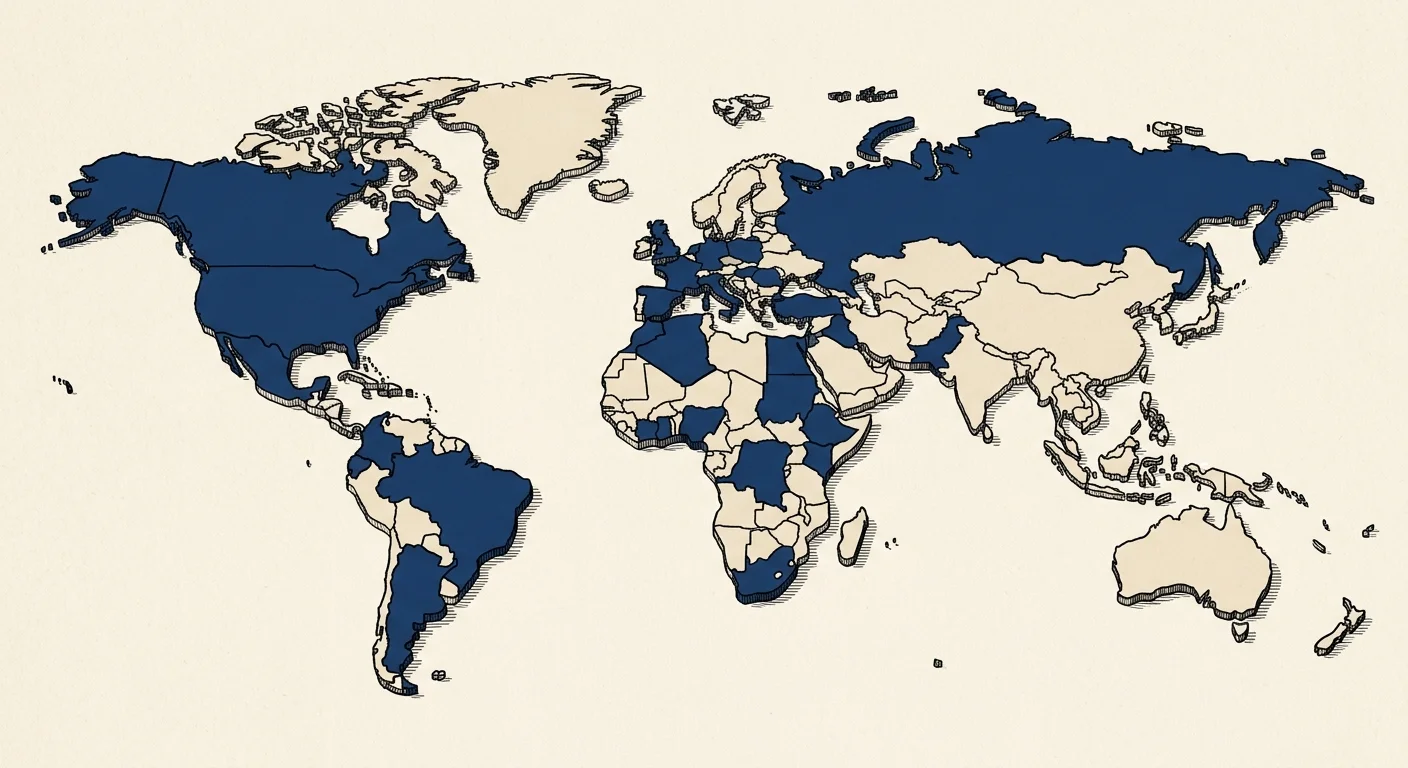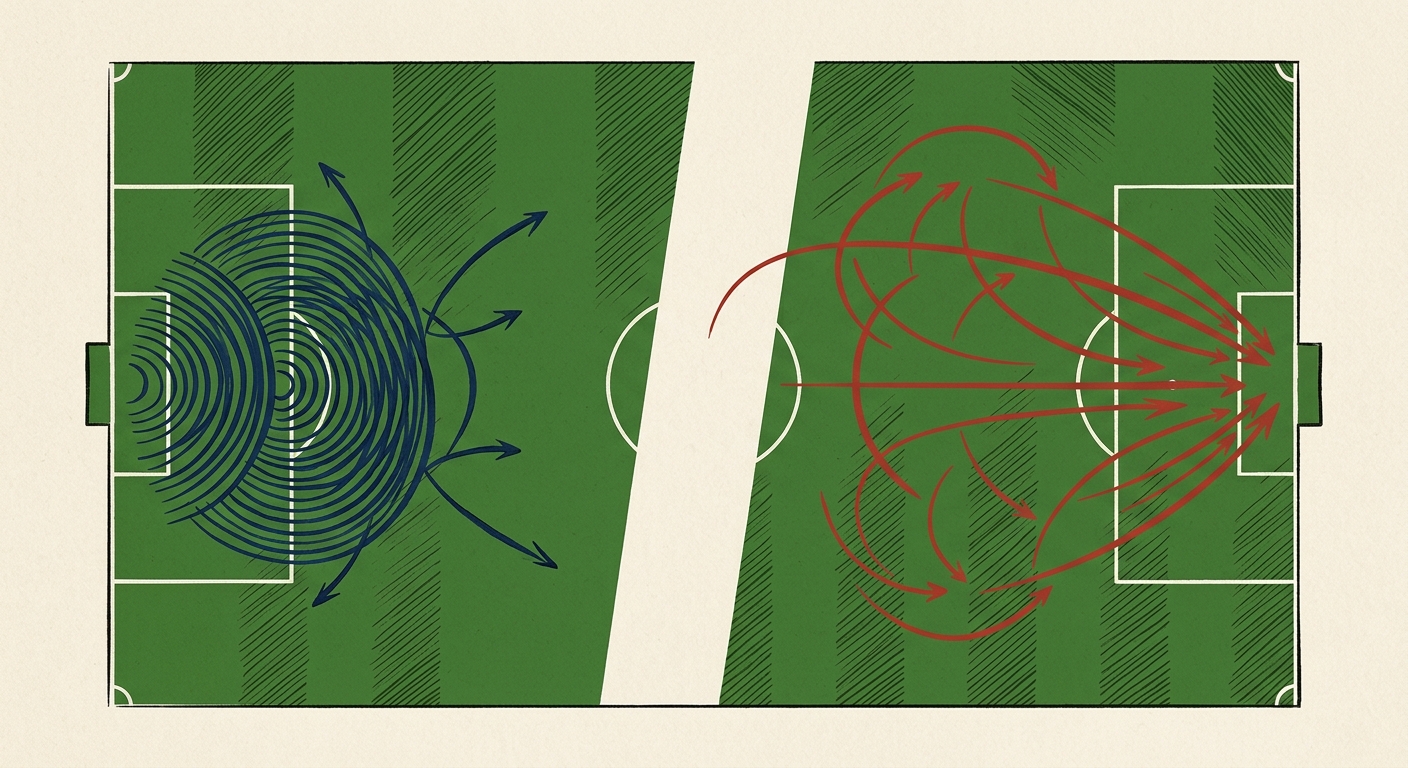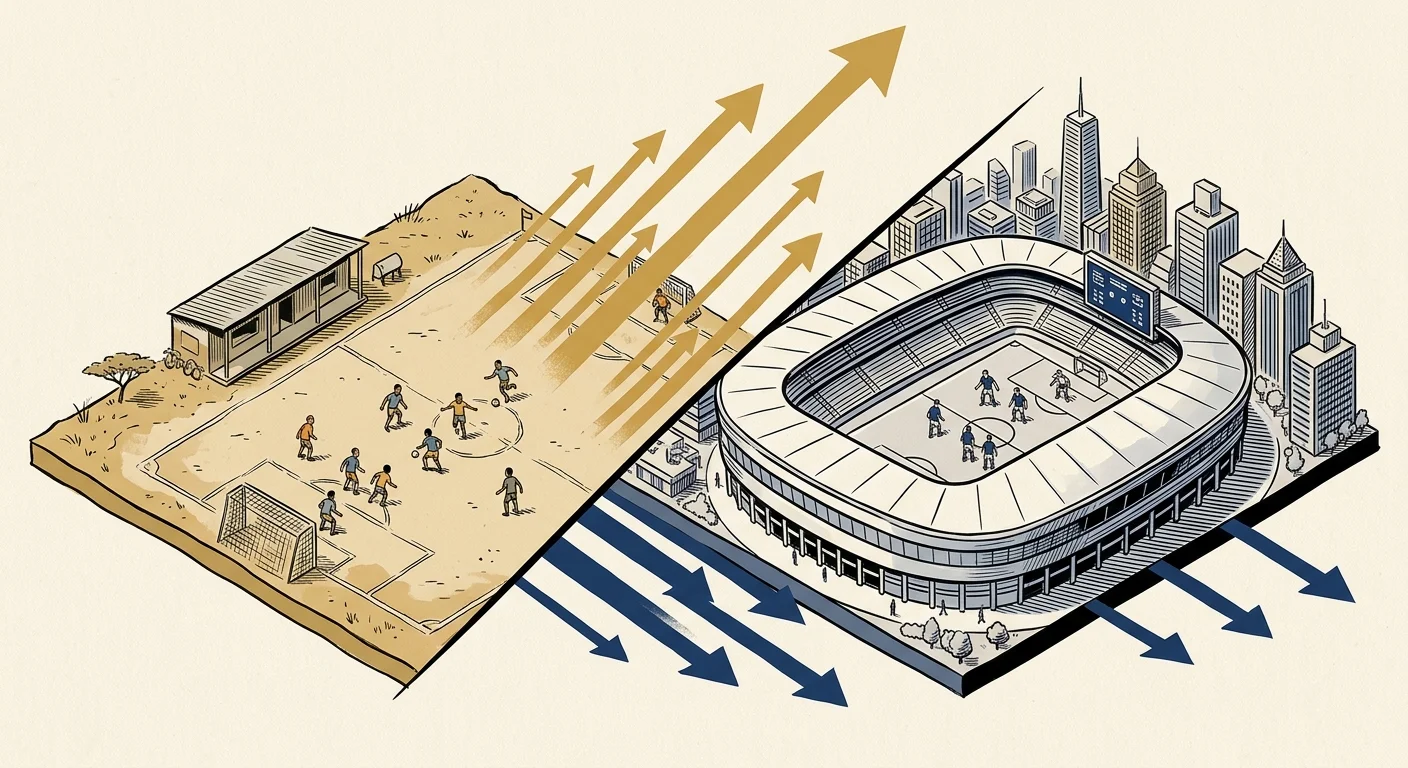
You'd predict the world's wealthiest football confederation would improve the most. The data says otherwise: UEFA barely grew (+10 ELO avg) while poorer CONMEBOL nations improved 10× faster (+106 avg) — and Asia's booming economies sent AFC backward (-28 avg), the only major confederation to decline.
For 17 years, Sepp Blatter presided over a global game that was supposed to spread football's wealth outward. The obvious prediction: UEFA's Champions League machine — worth billions annually — would produce ever-stronger national teams, while developing confederations fell further behind. A simple story of money compounding into quality.
Richer Countries Didn't Improve More, 1998–2015
Each dot is a country. Color = confederation. Richer countries are further right. Higher dots improved more.
Source: FiveThirtyEight / FIFA ELO ratings / World Bank GDP data
The scatter shows the pattern clearly. Colombia (+263) and Argentina (+169) anchor the top-center — CONMEBOL nations with outsized ELO gains. The single largest gainer is Philippines (+479), an AFC nation — an outlier that shows extreme variance within the confederation that still averaged -28 overall. UEFA nations cluster center-right — high GDP, near-zero improvement. Spain, Italy, France, England all declined. Norway, among Europe's wealthiest, fell 289 points — the steepest decline of any European nation, visible in the upper-right of the chart. One caveat: UEFA nations started from higher ELO baselines, which imposes a mathematical ceiling on improvement — but that alone cannot explain a -289 point collapse for Norway. The logic broke completely: the richer the confederation, the less it improved.
Average ELO Change by Confederation, 1998–2015
CONMEBOL (+106) improved 10× faster than UEFA (+10). AFC (-28) was the only major confederation to decline.
Source: FiveThirtyEight / FIFA ELO ratings (205 countries, Blatter era 1998–2015)
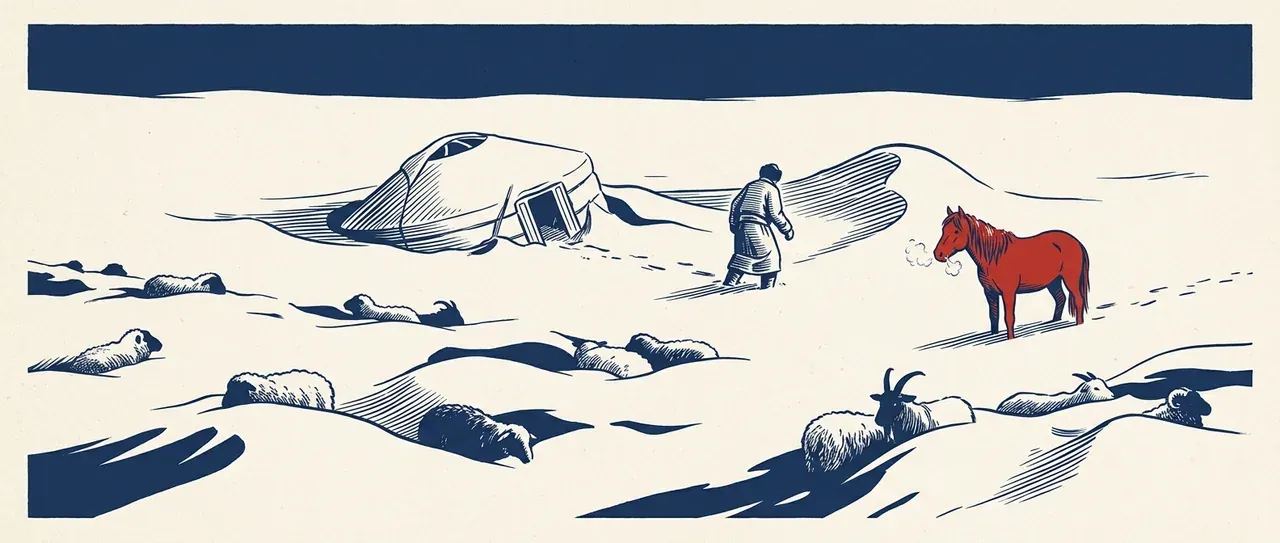
Asia presents the sharpest paradox. China, South Korea, Japan, and the Gulf states drove some of the fastest economic growth on earth during this period. Yet AFC averaged -28 ELO points — the only major confederation to move backward. (OFC, Oceania's confederation of Pacific micro-states, averaged -34 but comprises just 11 nations with negligible competitive history.) Mongolia, a middle-tier AFC nation, lost 106 points from an already-low base. Across an entire continent, economic development and football development ran in opposite directions.
The Blatter era didn't produce the football world that money predicted. Blatter's development funds distributed hundreds of millions to developing confederations — yet the improvement still bypassed Asia entirely. South American nations built genuine technical depth that no television deal could buy. Asian football administrations — flush with sovereign wealth and manufacturing revenue — couldn't convert economic power into footballing culture. The lesson is not that money is irrelevant. It's that football culture travels on different rails than GDP: it compounds through street games, school systems, and inherited obsession — not boardroom budgets.