Parliament Reset
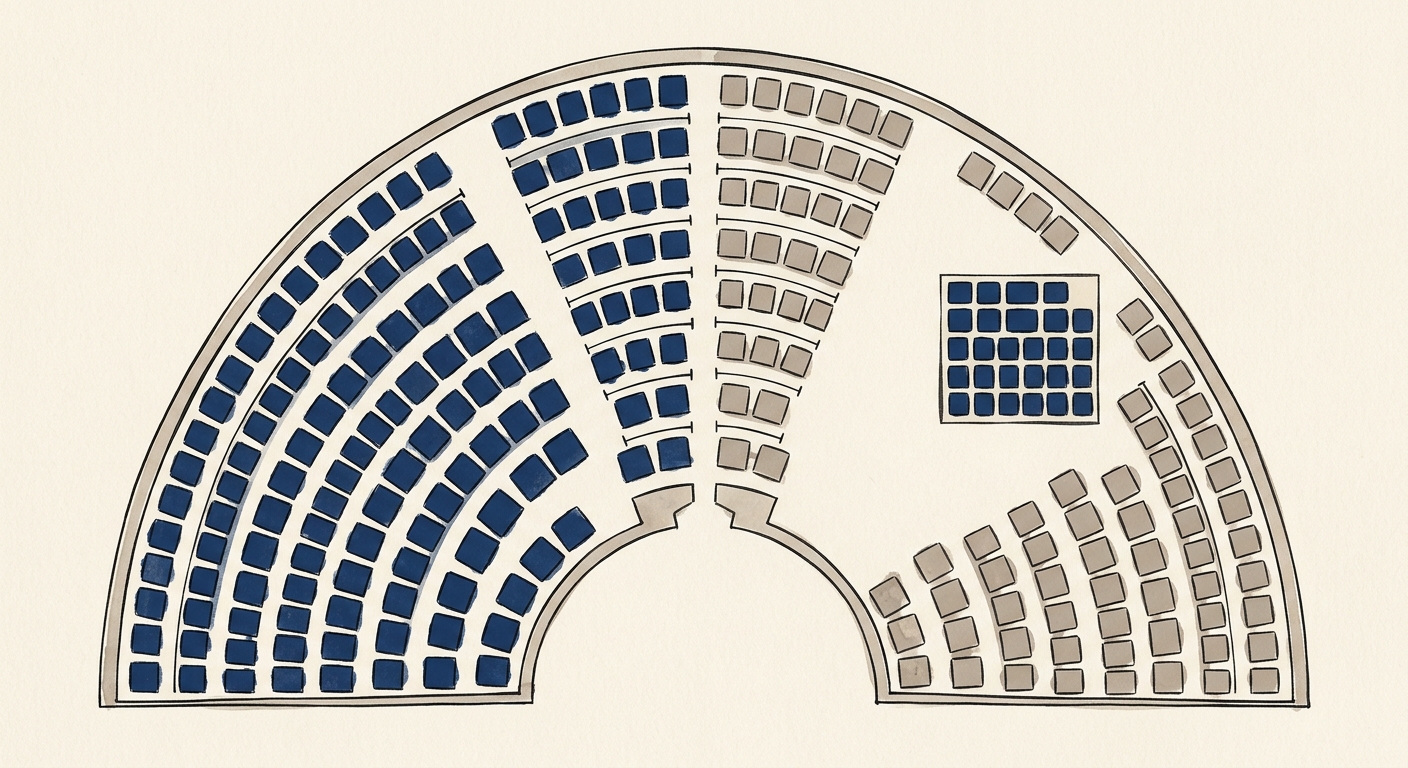
Mongolia's ruling party won 35 percent of the party-list vote on June 28, 2024 — and 54 percent of the seats. That 19-point gap is not a counting error. It is how the country's mixed electoral system works: first-past-the-post constituencies amplify a plurality into a majority. The Mongolian People's Party entered its new four-year term holding 68 of 126 seats, more than all other parties combined. The election also marked a structural change: parliament had 76 seats in 2016 and 2020. A constitutional amendment in May 2023 expanded it to 126, the largest legislature in Mongolia's post-1990 history.
Party-list vote share vs. seat share, 2024 State Great Khural election. MPP converted a 35% vote share into 54% of seats — a 19-point amplification. HUN, National Coalition, and CWGP all received fewer seats than their vote share would suggest under strict proportional allocation.
MPP Turned 35% of Votes Into 54% of Seats
Vote share vs seat share, June 2024 election. MPP's 35% of votes became 54% of seats.
Source: IPU Parline — Mongolia, June 2024 Election
Seat distribution in Mongolia's State Great Khural after the June 28, 2024 election. Total: 126 seats. MPP won an absolute majority with 68 seats (54%). Source: IPU Parline.
MPP Won More Seats Than All Others Combined
Seats won by each party in the 2024 State Great Hural election.
Source: General Election Commission of Mongolia
The opposition, spread across four parties, holds the remaining 46 percent of seats but is arithmetically unable to form a blocking coalition without DP leading and every smaller party agreeing to act together. DP itself won 30 percent of the party-list vote and converted that into 33 percent of seats — a modest upward distortion. HUN, which took 10 percent of the list vote, received only 6 percent of seats: the majoritarian system appears to have penalized the party's more diffuse vote distribution across constituencies. Mongolia enters its 2024–2028 parliamentary term with a structurally dominant ruling party and a formally enlarged but functionally fragmented opposition.
MORE IN POLITICS
9 Questions: How Well Do You Know Mongolian History?
The Price of Deterrence
The Monuments Presidents Make — and the Ones They Take Away
The $20,000 weapon that broke the math of modern war.