Visual Explainer
The Price of Deterrence
On April 13, 2024, Iran launched approximately 320 ballistic missiles, cruise missiles, and drones toward Israel — the largest direct attack in the Islamic Republic's history. A multinational coalition intercepted an estimated 99% of them (U.S. CENTCOM). The attack failed militarily. By the economics of modern deterrence, it succeeded: Iran spent roughly $100 million launching. The coalition spent an estimated $1.35 billion stopping. That asymmetry — cheap offense, expensive defense — is the defining logic of Iran's missile strategy. By the logic of deterrence economics, it does not need to land a warhead to alter the strategic balance.
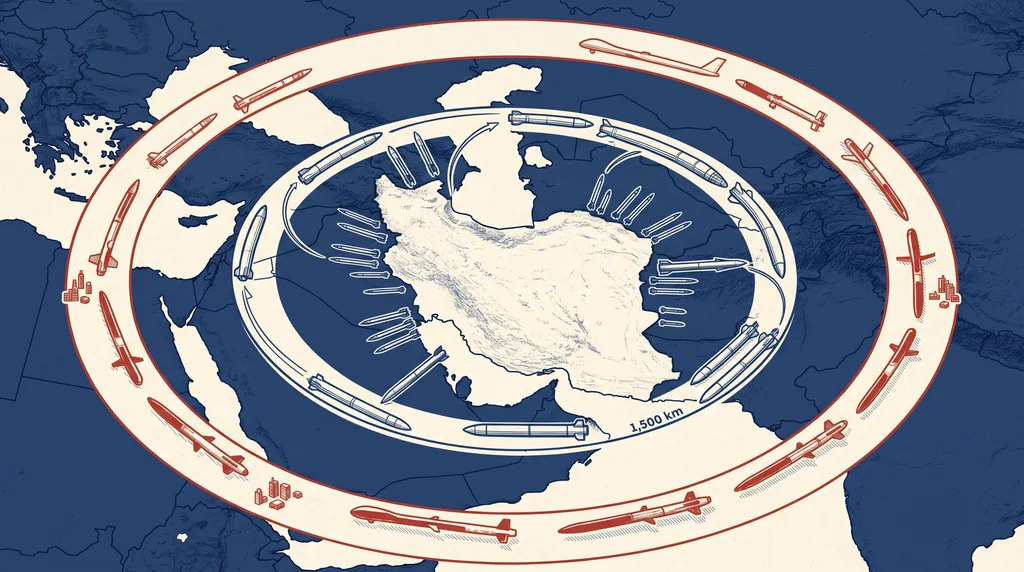
Iran's missile and drone reach — animated
Range rings from Tehran. Scroll to reveal each weapon system.
Source: CSIS Missile Threat Project; IISS Military Balance 2025
Iran's shortest-range ballistic missiles — the Fateh-110 family at 300 km — cover the border regions. From launch sites near the Iraqi border, they can threaten infrastructure and military positions just across the line.
The Zolfaghar extends the ring to 700 km. Baghdad — just 694 km from Tehran — now falls inside it. So does the Strait of Hormuz at 660 km, through which 20% of the world's oil supply passes.
The Shahab-3 — Iran's most widely deployed ballistic missile — pushes the ring to 1,300 km. Al Udeid Air Base in Qatar (1,070 km), home to US Central Command's forward headquarters, is now inside. So are Abu Dhabi, Riyadh, and every major Gulf capital.
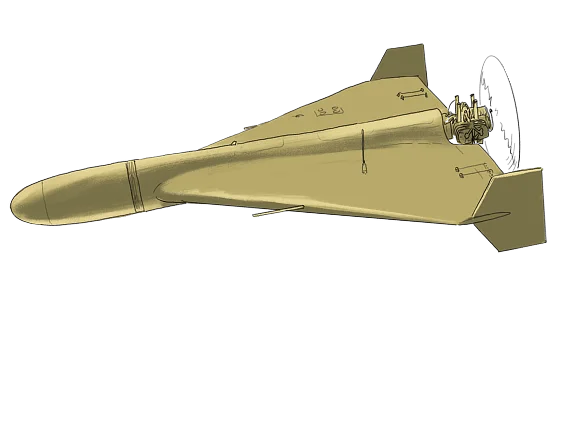
The Emad missile and Shahed-136 drone, both at 1,700 km, bring the ring to Israel. Tel Aviv at 1,585 km and Nevatim Air Base at 1,600 km cross the threshold. The April 2024 attack used these systems and proved they can reach Israeli territory. That 99% intercept rate reflected an unprecedented pre-mobilized coalition — the US, Israel, Jordan, and Saudi Arabia had hours of advance warning and coordinated airspace in ways that would not always apply.
Iran's Sejjil and Khorramshahr solid-fuel ballistic missiles reach 2,000 km. Ankara enters the ring at 1,775 km — making Turkey the first NATO member state whose capital falls inside Iran's fixed ballistic missile envelope. Every major Turkish military installation is now theoretically within range.
Iran claims the Kaman-22 long-endurance drone can reach 3,000 km — a figure cited in Iranian state media but assessed by IISS and CSIS as closer to 2,000 km. If the claimed range holds, Sanaa at 2,370 km crosses the threshold. If it does not, Iran's Houthi proxies already operate there in either case — extending the threat without Iran launching a single missile from its own soil.
Iran's full arsenal at a glance — maximum reported ranges
Maximum reported range in km for each Iranian weapon system.
Source: IISS Military Balance 2025; CSIS
The ring explains the arsenal. But the Houthi campaign in the Red Sea revealed the second layer of Iran's strategy — proxy reach. Across five monthly snapshots from November 2023 to October 2024, Suez Canal transits fell from 2,068 in November 2023 to 877 by October 2024 — a 58% decline between those two points. Global shipping rerouted around Africa, adding weeks to journey times and sharply higher freight and insurance costs — UNCTAD estimated the 2024 Red Sea disruption imposed hundreds of billions of dollars in annualized rerouting and insurance premiums on global trade. Iran achieved a global economic disruption without firing a single weapon from Iranian soil.
Suez Canal traffic collapsed — from 2,068 to 877 across five monthly snapshots, Nov 2023 – Oct 2024
Monthly vessel transits, Nov 2023 – Oct 2024. Houthi attacks triggered 58% collapse.
Source: Suez Canal Authority
The April 2024 interception illustrated the central paradox of Iran's missile strategy: a successful defense does not make the offense cheap to face. The coalition stopped 99% of incoming weapons — using Arrow-3, THAAD, Patriot, and US Navy SM-2 interceptors — at an estimated total cost roughly 13.5 times Iran's outgoing expenditure — $1.35 billion to stop a $100 million salvo (open-source estimates derived from reported unit costs and intercept quantities; no official government accounting has been published). Every future attack forces the same calculation. Iran manufactures Shahed drones at an estimated $20,000 to $50,000 each. Arrow-3 interceptors cost approximately $3 million per shot. The math runs in Iran's favor as long as it keeps launching.
MORE IN POLITICS
9 Questions: How Well Do You Know Mongolian History?
Mongolia's Corruption Score Has Fallen for a Decade. The Coal Scandal Explains Why.
The Monuments Presidents Make — and the Ones They Take Away
Parliament Reset